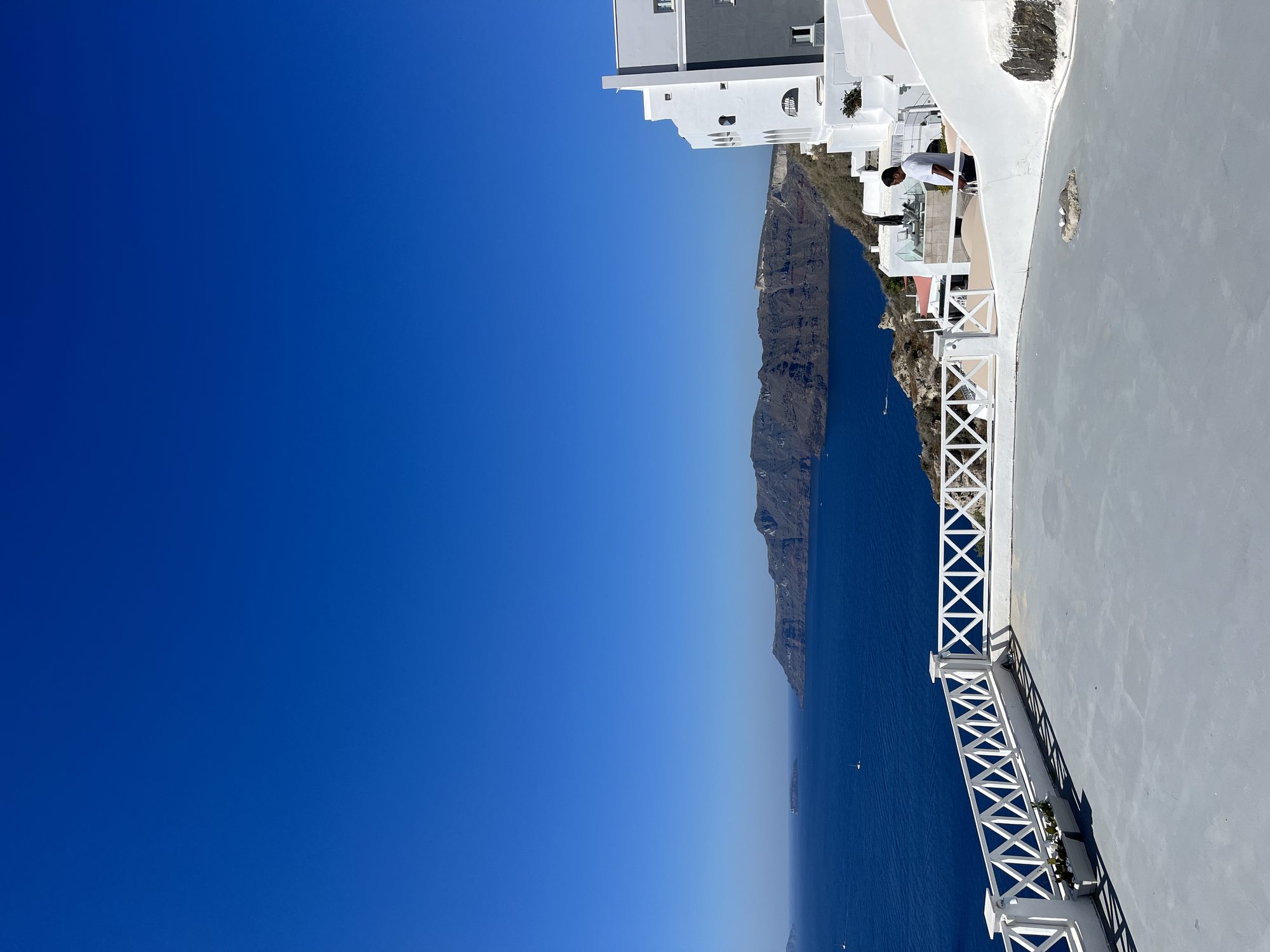
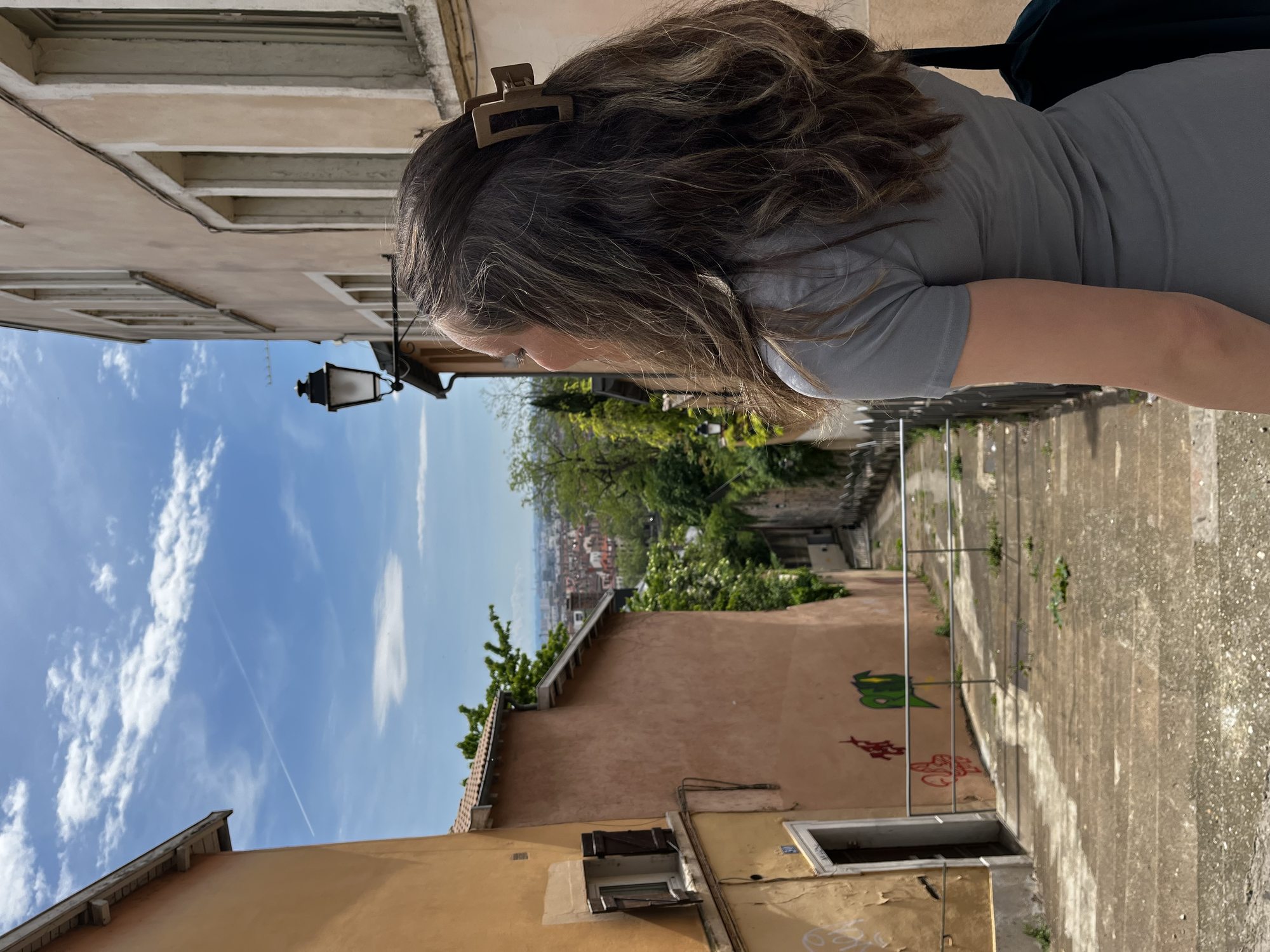
Go. Corfu is the most un-Greek Greek island — and that is exactly the reason to book it.
The full verdictYou should go to Corfu. And once you get there, you should leave the part of you that thinks it knows what a Greek island feels like at the airport.
My girlfriend and I went for five days in May, expecting the kind of trip the Greek islands have trained all of us to expect — whitewashed cubes on a cliff, blue domes, a windmill, a sunset crowd holding wine glasses up against the same sky a thousand other people are photographing. That is one Greece. It is a real Greece. It is the Greece I wrote about in the Athens vs Santorini guide, the one I argued with myself about in is Santorini overrated, and the one I went deep on the capital version of in my Athens essay. But it is not Corfu. Corfu, the more time you spend on it, refuses to perform that Greece for you. It is green, not white. Venetian, not Cycladic. Lush, not bare. Bilingual in a way that took us three days to even notice. And the food sits on the table looking like it was cooked in someone's mother's kitchen — because, very often, it was.
If you are building a full Greek week, Corfu also fits in as a complete replacement for Mykonos in the 7-day Athens-Santorini-Mykonos itinerary — different rhythm, calmer island, the same quality of trip.
If you have already done Santorini, Mykonos, and the Cycladic line and you think you know Greece — Corfu is the next island to book. It is the island that was never Ottoman, that spent 400 years under Venice, that the French built a Parisian colonnade across, that the British left cricket and ginger beer on, and that grows kumquats in its inland villages. The beaches are spectacular. The food is honest. The history is on every corner and most of it is not on any sign.
Every piece here ends with an honest call on where to actually go. New verdicts land in your inbox first. One email. No noise.
The Honest Case Against Corfu
Let me give the argument its full credit first, because it deserves it.
Corfu is not the photograph. If you are flying to Greece for the first and possibly only time and you want the white-cube-blue-dome image you have had in your head since you were sixteen — Corfu will not give you that. The buildings are pastel. The roofs are terracotta. There is moss on the stone walls. The hills are dark with cypress and olive trees, not the bare volcanic rock you have seen on a thousand reels. If your goal is the postcard, Santorini is going to do that better.
Corfu is also not small and not walkable. It is a real island, fifty kilometres long, with two coasts and a mountainous spine running between them. The west coast — where the famous coves are — is an hour's drive from the east coast where the Old Town is. You need a car. You need to be willing to drive narrow roads with goats on them. You need to accept that one day you wake up in a green valley and the next day you walk under a French colonnade.
And — full transparency — May is not high season. The sea on the west coast is warm enough to swim in if you are committed, cold enough to think twice about it if you are honest. The summer crowds are not yet there, which is exactly why we went then. But that also means a few restaurants are closed, a few beaches are still being raked, and the famous boats out of Paleokastritsa to the sea caves only run on the days the weather decides to cooperate. The trade-off, in my opinion, is more than fair. But it is a trade-off.
"Same country — different country."
Now — what really matters.
Paleokastritsa — the cove that didn't sound Greek
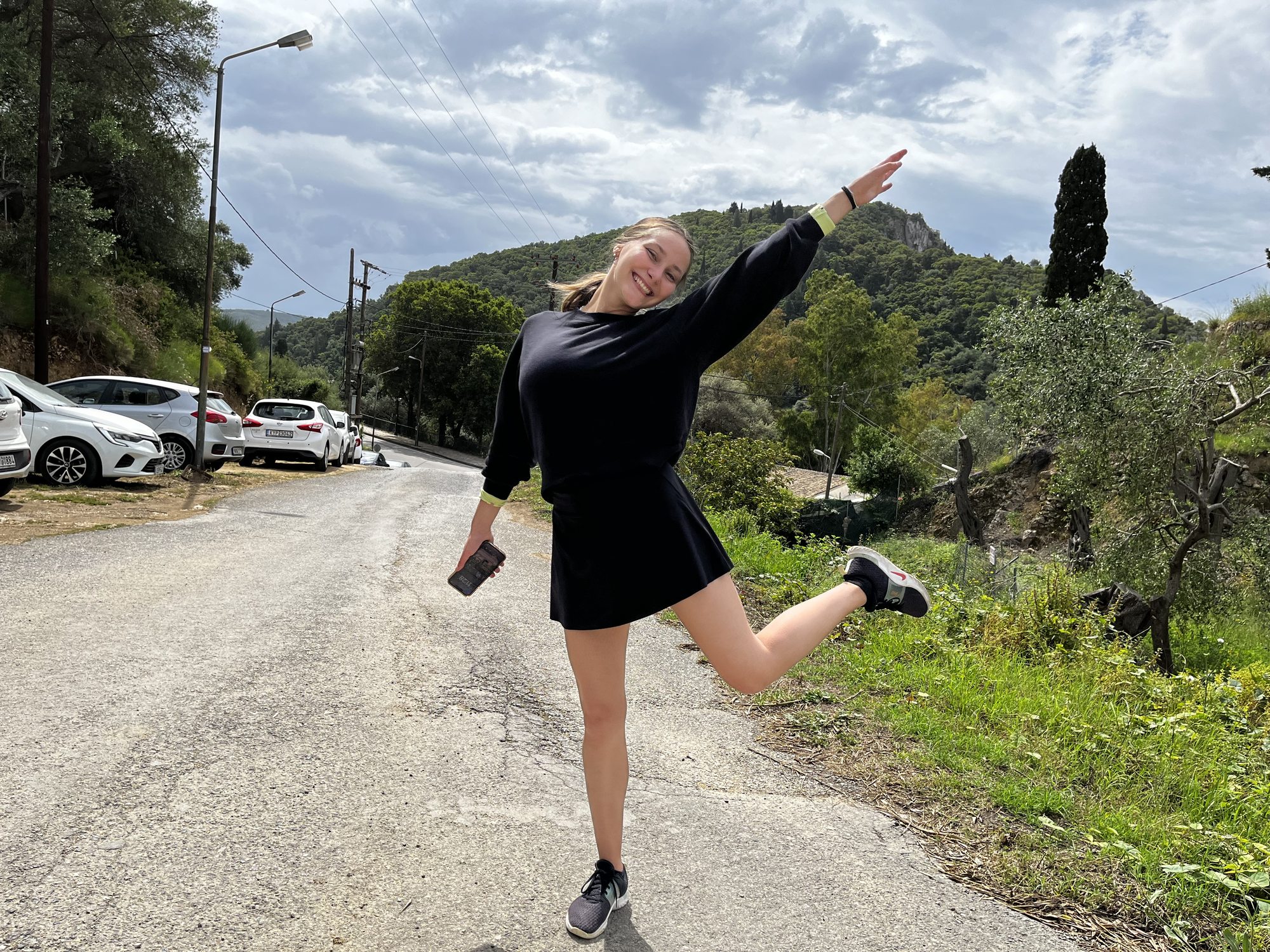
We based ourselves on the west coast, in a small set of villas above the bay of Paleokastritsa. The drive in was the first sign that this trip was going to be its own thing. You come down through a gorge of pine and cypress, the road narrowing to one-and-a-half lanes, and then the sea opens up below you in this colour that is not Aegean blue. It is greener. It is the colour the Caribbean gets in the shallow parts of a cove. Cliffs rise on either side, and at the bottom there is a curved sand beach maybe two hundred metres long.
The whole thing looks like somebody took a Croatian fjord, a Sardinian beach, and a Greek monastery, put them in a blender, and poured the result into the only place that was geographically equipped to hold all three.
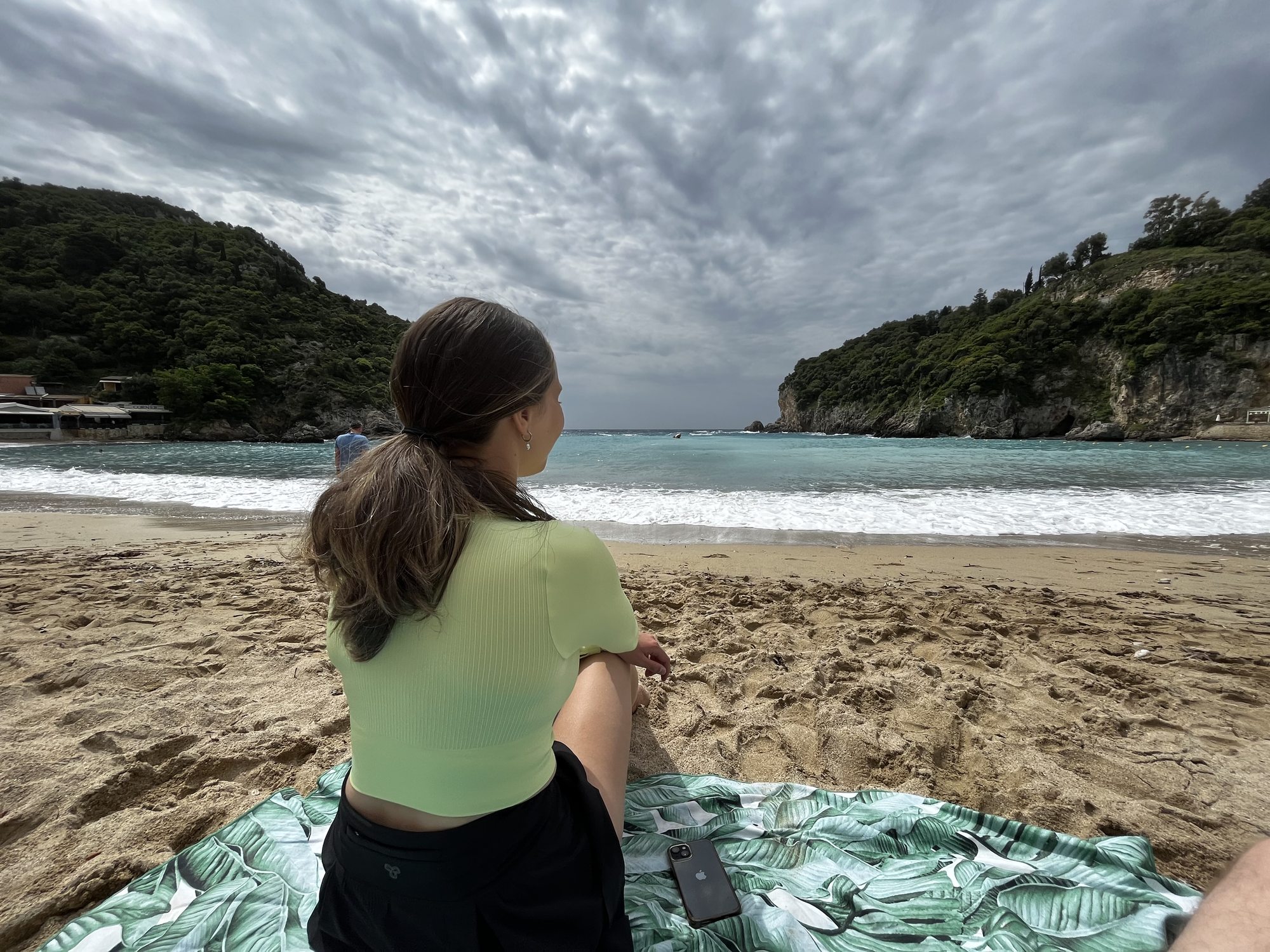
The cove is called the bay of Agios Spyridon, technically, but everyone calls the whole stretch Paleokastritsa, after the monastery on the headland above. The monastery is white-painted, 13th-century, still functioning, and you can climb up to it for free. The monks sell honey. The cats sleep on the courtyard tiles. From the terrace you can see five other coves stretching down the coast, each one a smaller version of the one below it, each one with its own beach, each one reachable only by boat or by a path that nobody marks.
I will be honest with you: I had been to Greek islands before this trip. I had been to Santorini — and you can read what I think about that one in is Santorini overrated. I had been to Crete and Mykonos, and the case for the latter, against Santorini, I made in Mykonos vs Santorini. None of them prepared me for the sheer green of Corfu. There are more than four million olive trees on this island, planted under Venetian decree four hundred years ago — Venice paid Corfiots a bounty for every tree they planted, and the trees are still standing. Walking from the cove back up to the road, we passed through olive grove after olive grove, the silver leaves moving in the wind, the cicadas absolutely deafening. It felt closer to Sardinia than to anywhere else I had been in Greece.
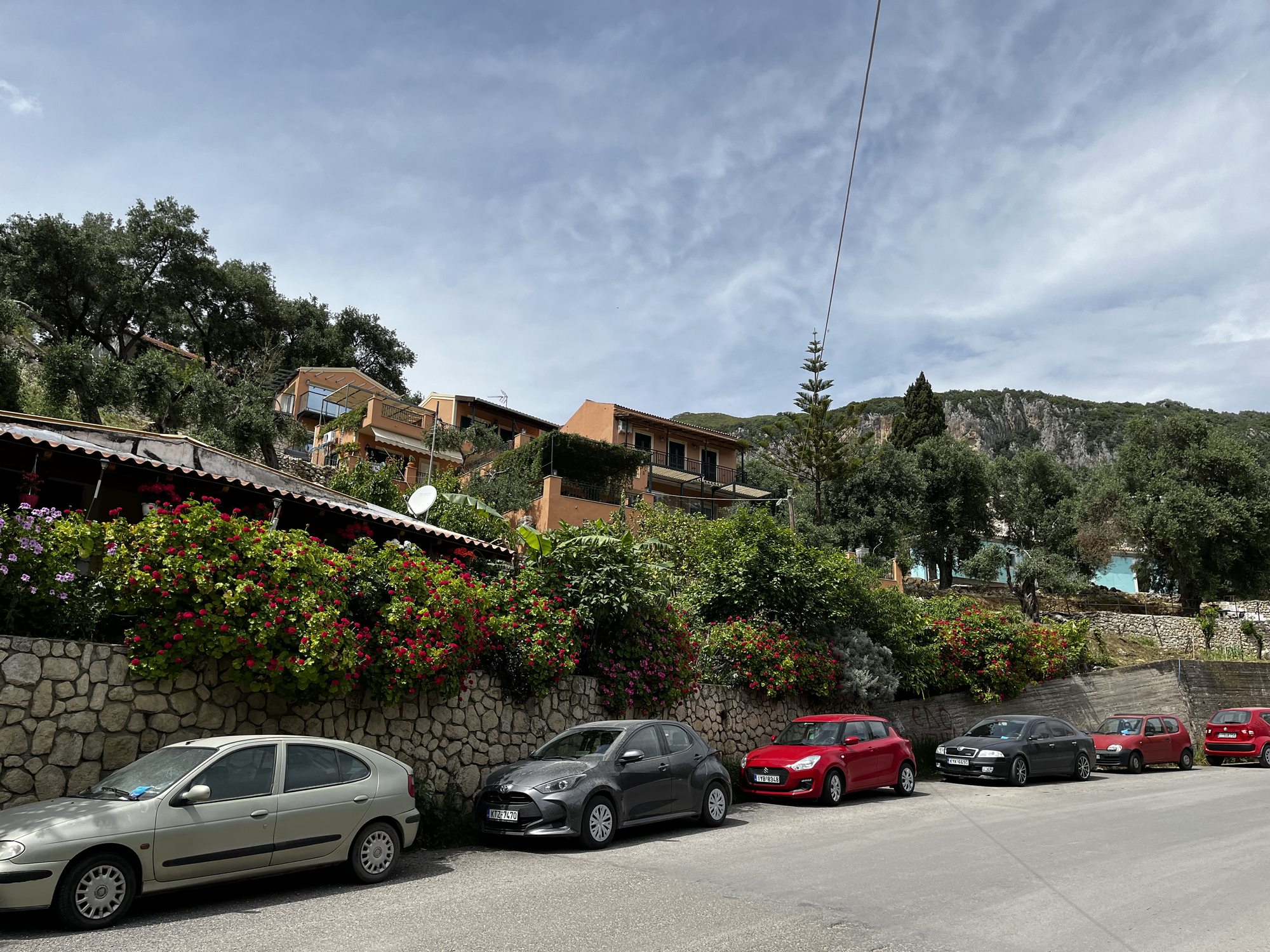
A dog we named Oreo — and the moment that fixed the trip in memory
On the second day at the beach, a dog came over.
He was black on top, white on the chest and paws, medium-sized, possibly a Greek shepherd mix, completely calm. He did not beg. He did not bark. He sat down a polite three feet from our towel, looked at the sea for a while, then looked at us, then put his head down on his front paws.
We didn't feed him. We didn't pet him aggressively. He stayed for an hour. Then he wandered off. The next morning he was there again — at the same spot on the sand, like he had a reservation.
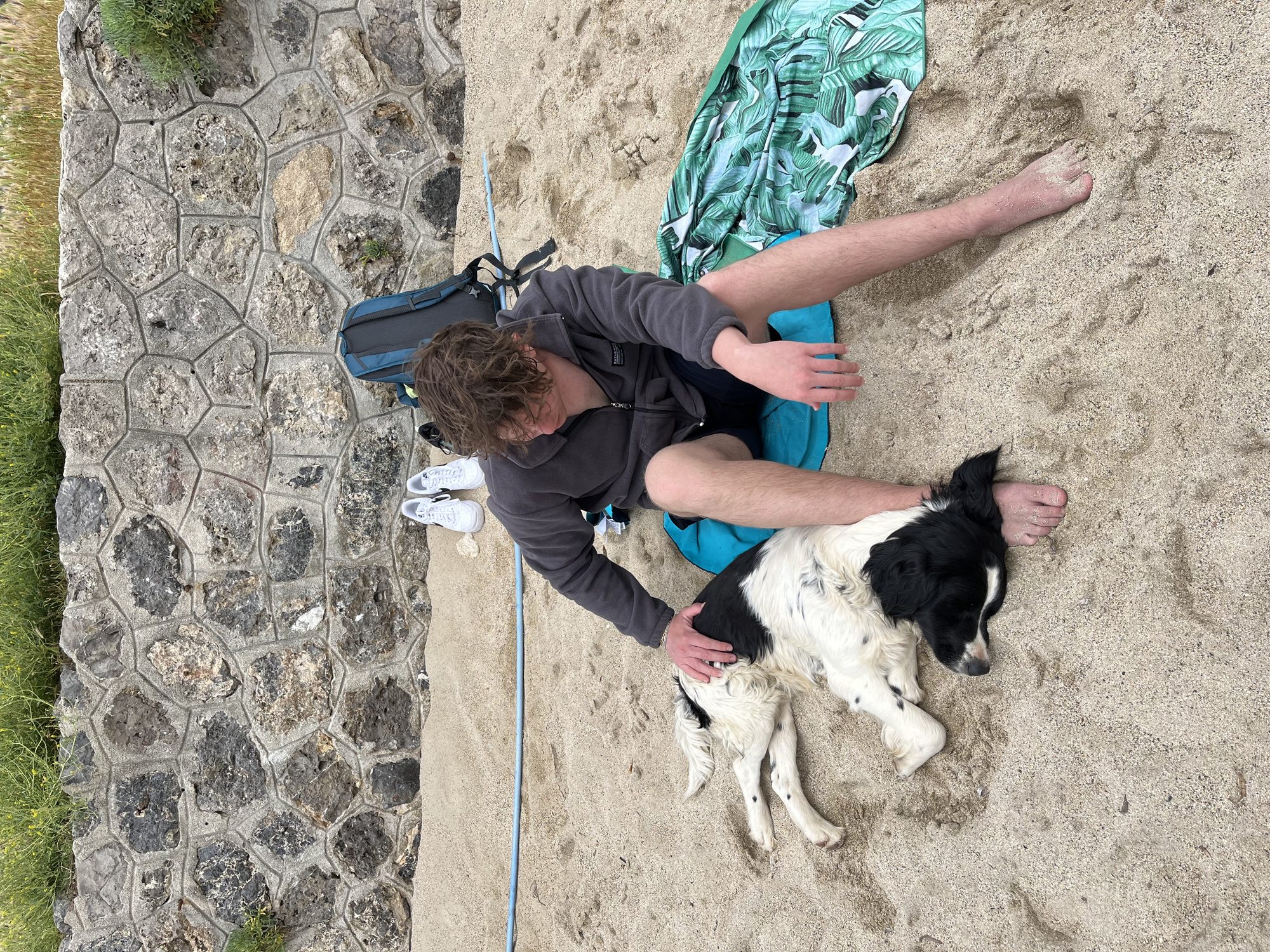
We called him Oreo because he was black on top and white underneath and we couldn't help ourselves. By day three he was walking us up the path back to the road in the afternoons. By day four we were buying an extra piece of bread at the bakery so we'd have something to share at lunch. By day five — when we were checking out — my girlfriend cried in the car for ten minutes.
This is the part of the trip I think about most. Not the cove. Not the food. Not the fortress. The dog on the sand, who picked us out of a beach full of people, sat with us without asking for anything, and was gone by the time we drove off the island.
I will not tell you Greek beach dogs are always going to find you. Sometimes you go on a trip and the small things do not happen. But I will tell you that the way to set yourself up for them is to slow down enough that they can. We had nowhere to be for five days. We were not on a cruise schedule. We were not chasing islands. Corfu rewards the kind of trip where you sit on a beach for three afternoons in a row in the same spot. The Cycladic trip — the four-islands-in-seven-days trip — does not give you the time for a beach dog to choose you. It is the same instinct I argued for in Sorrento vs Positano on the Italian coast — pick the slower base, build the trip outward from it, let the small things happen.
"Corfu is a slow trip. Try not to fight it."
The food — the kind that doesn't change for tourists
I will say something now that I have said about Naples, said about Lyon, and will keep saying for as long as there are travel blogs telling people to eat at the place with the English menu and the big photographs in the window: follow the locals. On Corfu this rule is easier than anywhere else I have been in Greece, because the tourist places are obvious and the real places are everywhere else.
The food on Corfu is not the food of the Greek mainland. There are no gyros stands on every corner. The grilled-fish-and-tzatziki menu exists, but it is not the dominant menu. What you actually eat on Corfu is closer to the food of Venice and Apulia than to anything Athenian — slow stews, pastas baked into shapes you don't see elsewhere, sauces with cinnamon and tomato and red wine. The flagship dishes have Italian-sounding names in Greek mouths: pastitsada, sofrito, bourdeto, bianco. They are Corfu's own. You cannot get them in Santorini. You can barely get them in Athens. If you have read my Naples vs Rome guide you already know my position on cinnamon-and-tomato meat sauces — that pattern, the one Naples taught me to recognise, is alive and well on this island and nowhere else in Greece.
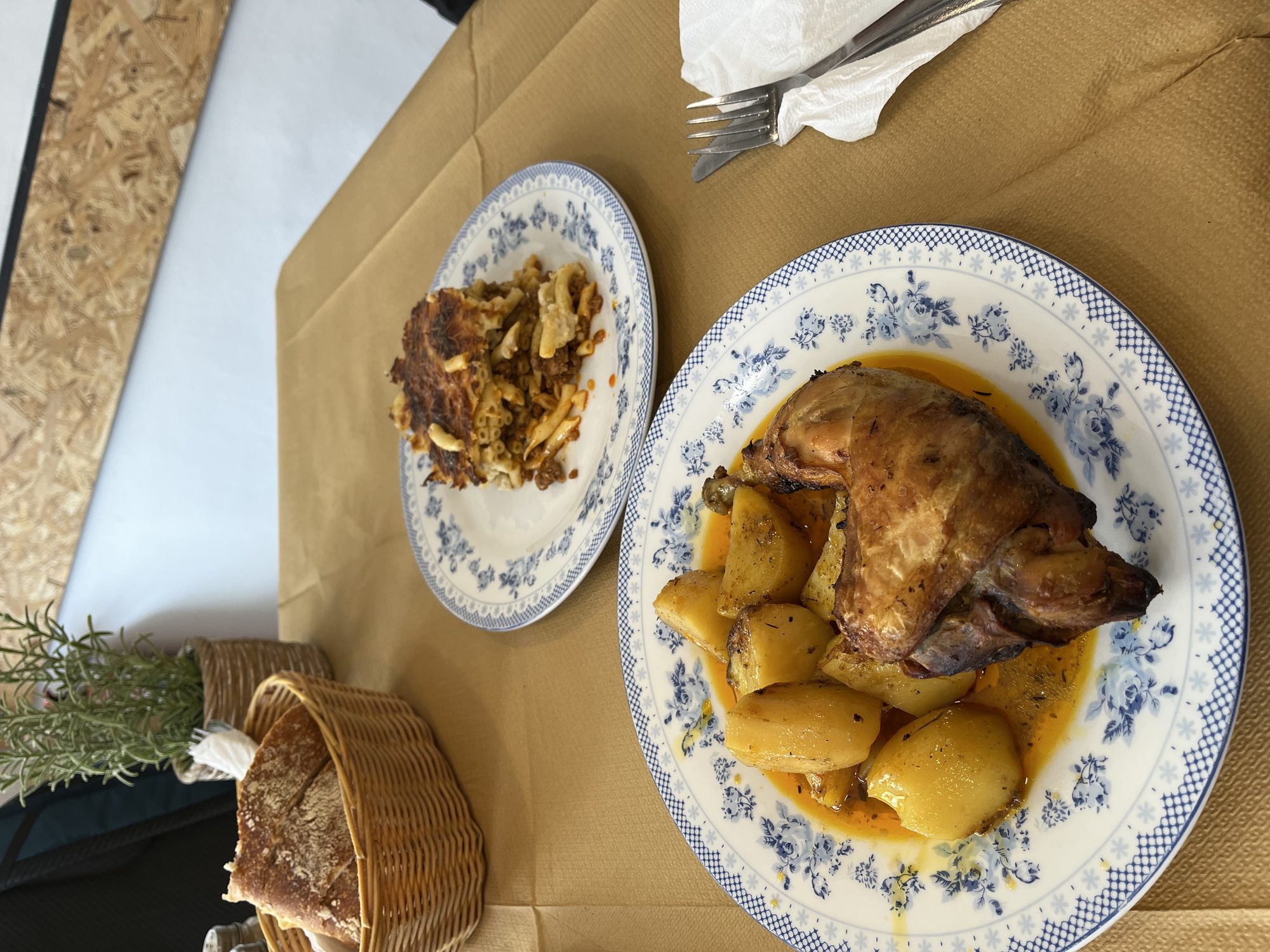
The pastitsio I had on the second day — pictured below — is the one I keep going back to in my head. Pastitsio is the Greek lasagne, sort of: layers of long pasta tubes bound together with a meat sauce and topped with a thick béchamel that the cook is supposed to brown deeply, almost to the edge of burnt, in a wood oven. The version we ate in Corfu was the version a Corfu grandmother would have served you in 1980. Béchamel almost mahogany on top. Sauce dark with cinnamon and red wine. Pasta still with a small bite to it. Served on a blue-and-white plate that had clearly been in the family longer than the pasta had been on the stove.
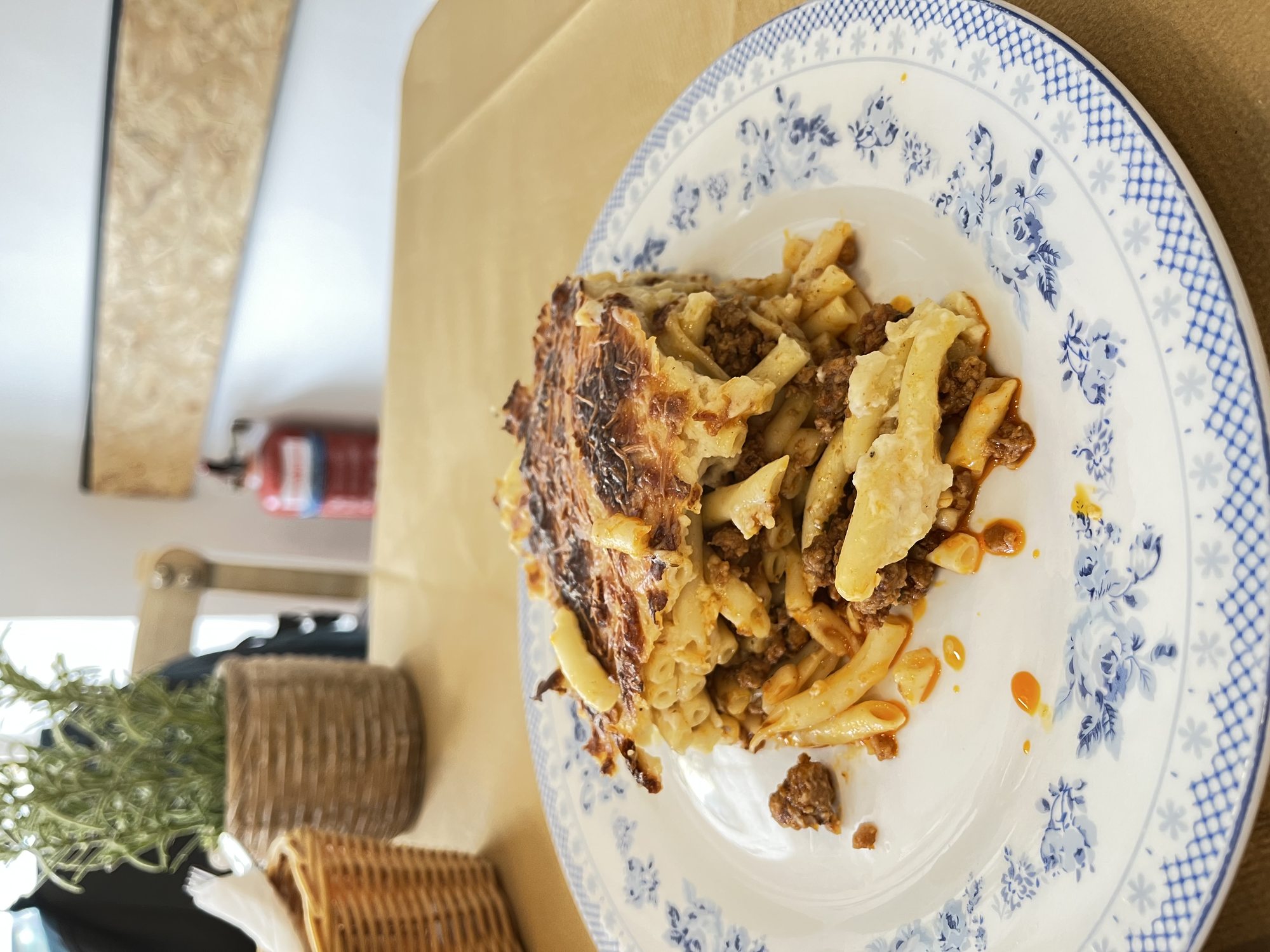
The other thing about Corfiot food is the wine. Greek wine is having a moment everywhere — the assyrtikos out of Santorini, the agiorgitiko reds out of Nemea. But Corfu has its own grape and its own wine and you cannot drink it anywhere else.
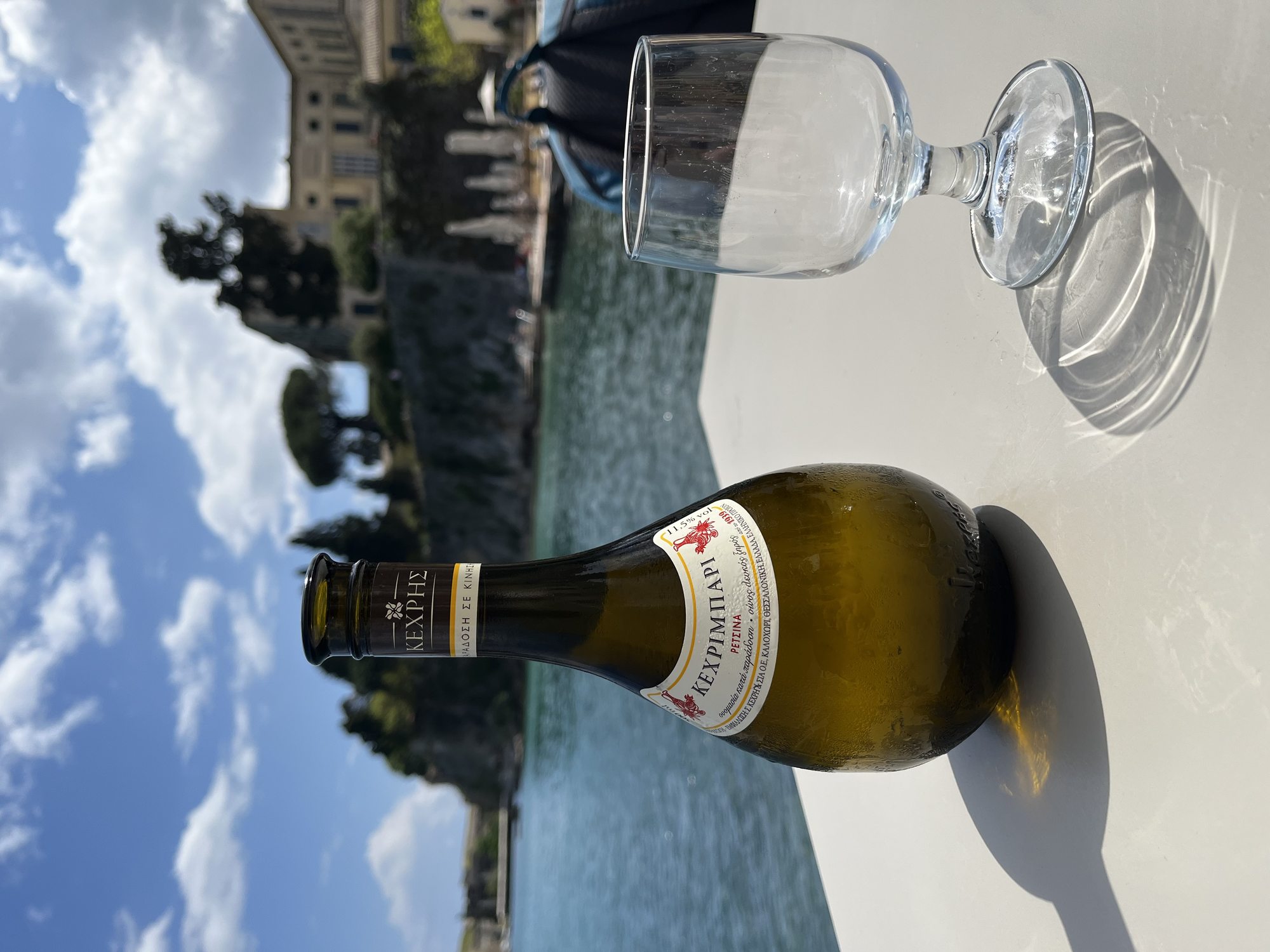
The cabbage salad in the photo above — the one next to the chicken — is its own quiet point. Corfu does cabbage the way the rest of Greece does horta. Shredded fine, dressed with olive oil and lemon and a little vinegar, occasionally a grating of carrot. Every taverna serves a version of it. It is the most Venetian-feeling thing on the table — the kind of side dish you eat in Friuli, not what you'd expect on a Greek island.
The history we did not know we were standing in
We came to Corfu for the beaches. We did not come for the history. We had not done the reading. We did not know, walking into the Old Town on our last morning, that we were walking into one of the most consequential pieces of Mediterranean geography that nobody has heard of. The closest thing I can compare the feeling to is the day we walked into Pompeii without any preparation — which I have written about at length in Is Pompeii Worth Visiting. Same shape of surprise. You think you are showing up for a beach and you end up reading plaques for three hours.
Let me say this plainly, because I had to learn it: Corfu is the only Greek island that was never under Ottoman rule. Every other Greek island, every part of the mainland — all of it, for hundreds of years, was Ottoman. Not Corfu. Corfu spent four hundred years under Venice, then briefly under Napoleonic France, then almost fifty years under the British, and only became Greek in 1864 when Britain handed it over as a wedding present to a Greek king. That timeline is not a footnote. It is the entire reason this island looks, tastes, sounds, and feels different from everywhere else in the country. The Italians are still in the language. The French are still in the architecture. The British are still in the cricket pitch in the middle of town and in the ginger beer in the corner shops.
The fortress that saved Western Europe
The Old Fortress of Corfu is the thing you see from the cafés on the Spianada — a long Venetian fortification on a small rocky promontory jutting into the harbour, two hills on it, a chapel on top of one, a lighthouse on the other. We had walked past it three times before we sat down and read the plaque.
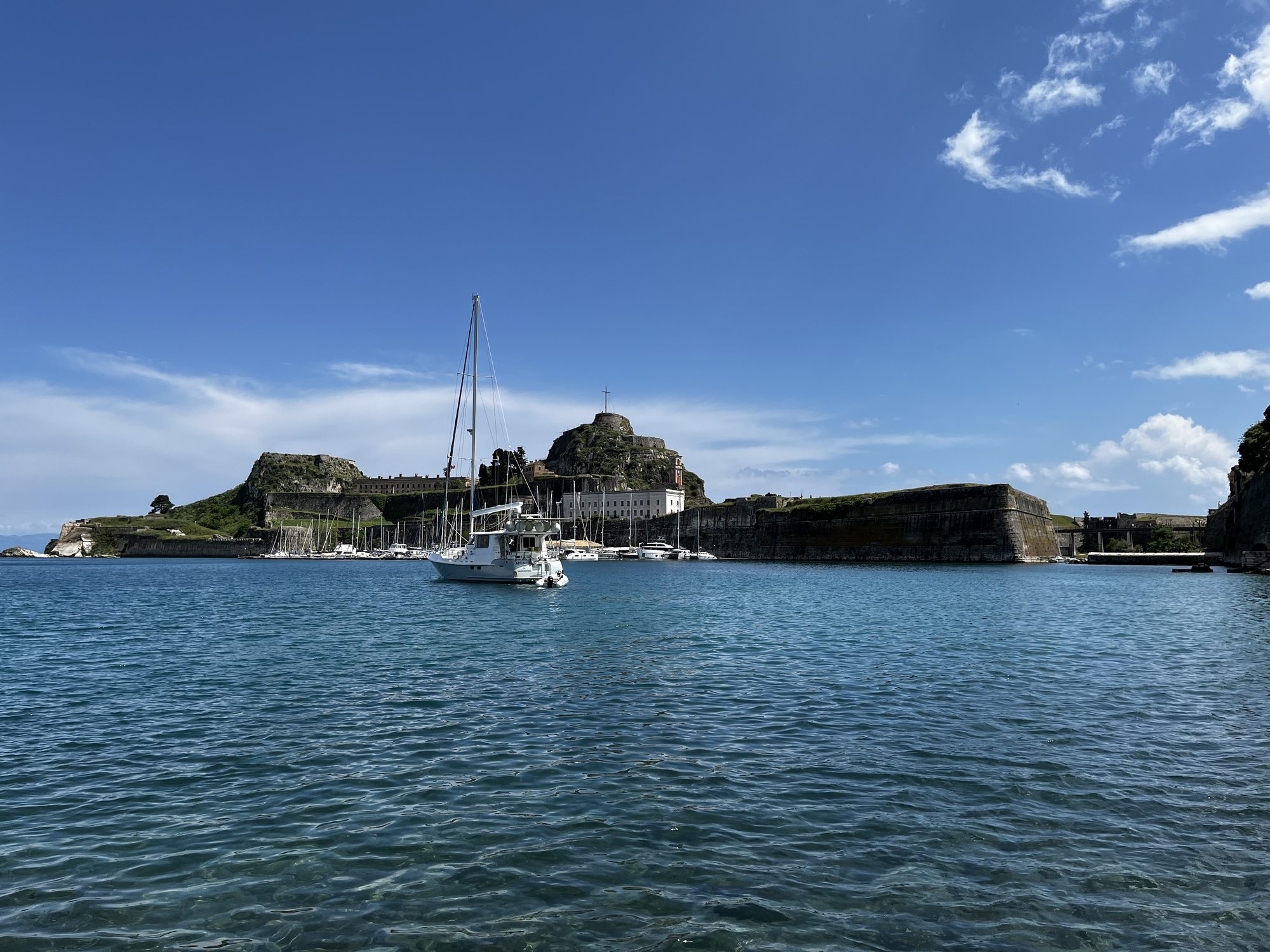
The statue most visitors walk past
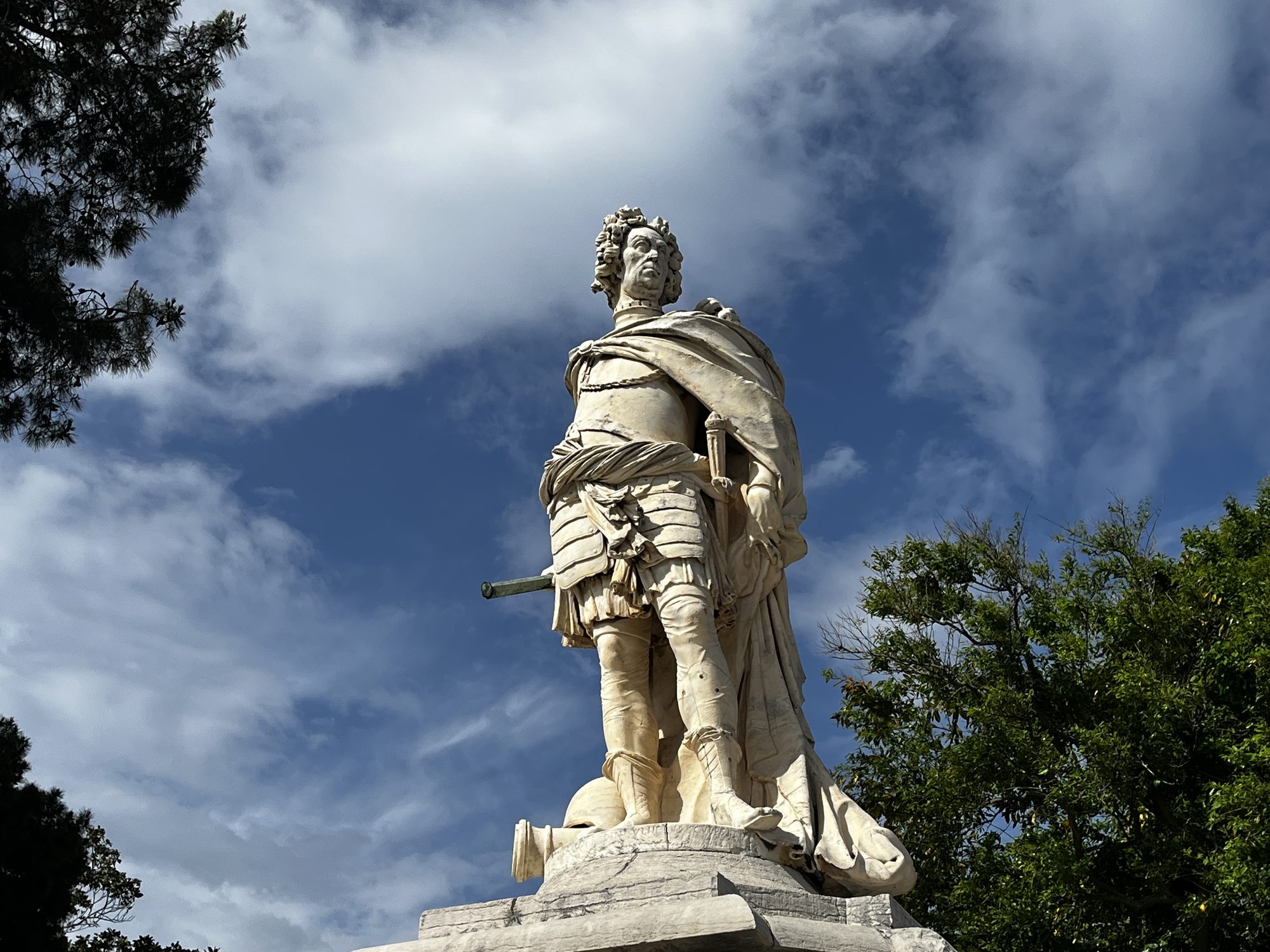
On the Spianada — the green park between the Old Town and the fortress, which is itself the largest square in the Balkans — there is a marble statue of a man in Roman armour with a sword. He looks like a generic European monument. He is not. He is Field Marshal Johann Matthias von der Schulenburg, a German mercenary in the service of Venice, the man who actually commanded the defence in 1716. The Venetian Senate paid for the statue while he was still alive. He is the only person in Venetian history to be honoured that way.
The colonnade the French built
Cross the Spianada from the Schulenburg statue and you reach the Liston — a long covered colonnade of cafés along the western edge of the square. The Liston was built in 1807 by the occupying French, who modelled it directly on Paris's Rue de Rivoli. It is the only piece of Rue de Rivoli outside of Paris. We had a coffee under it without knowing any of this.
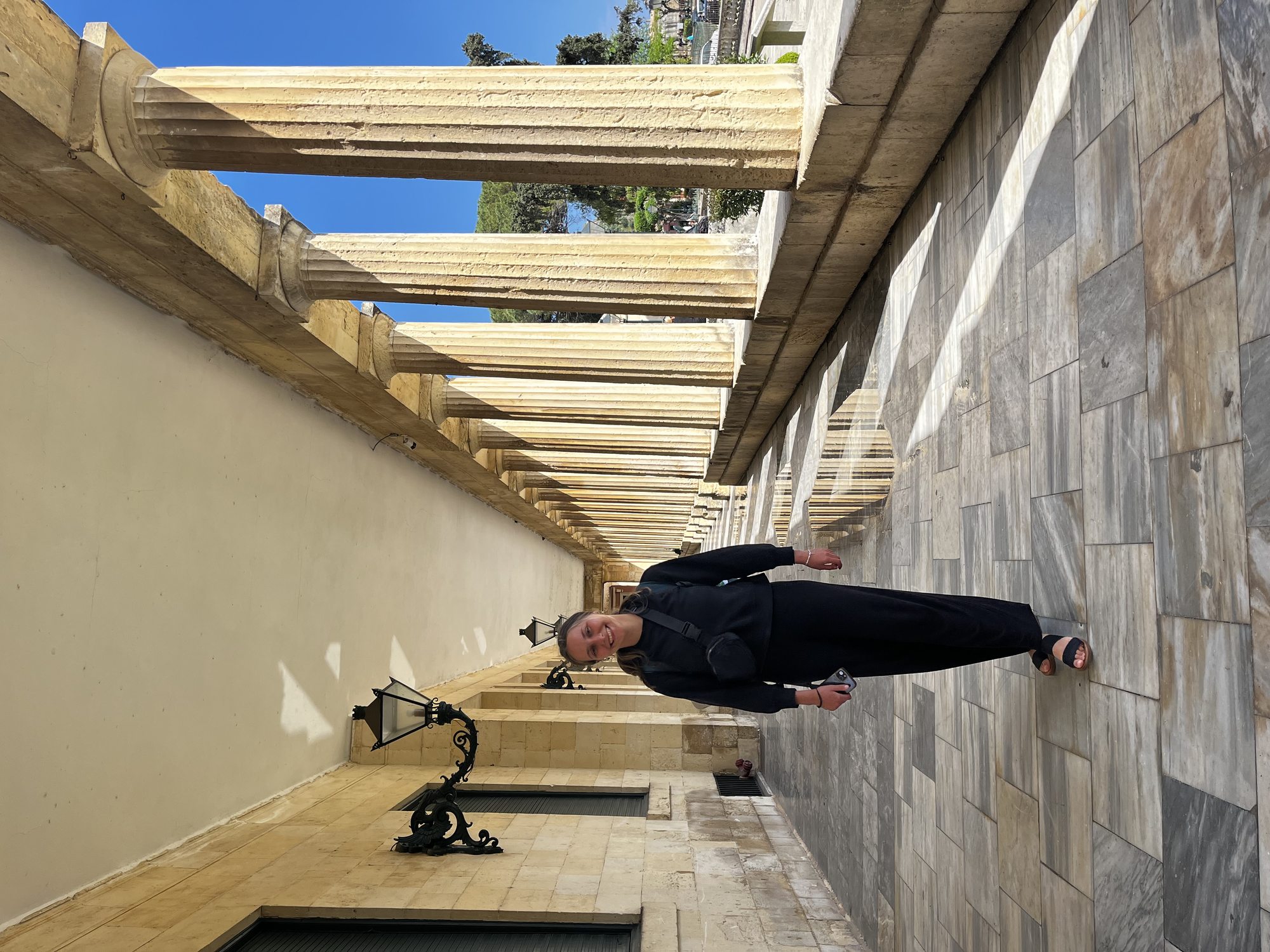
This is the thing about Corfu's history that I think travel writing has done a bad job of communicating: it is not "Greek with an Italian flavour." It is a place that was Italian, then French, then British, then Greek — in that order, in deep ways, over real time — and every single one of those layers is still physically present in the streets. The Italian is in the food and the language. The French is in the architecture and the planning. The British is in the cricket pitch on the Spianada, in the bottles of ginger beer in every corner shop, in the kumquat trees the British planted, and in the absurd fact that Corfu was, for a brief period, ruled from London. The Greek is the topmost layer. It is loud. It is the layer that puts the souvlaki on the menu and the flag on the church. But underneath it are four others, and you can see them from anywhere you sit down for coffee.
The west coast in two evenings
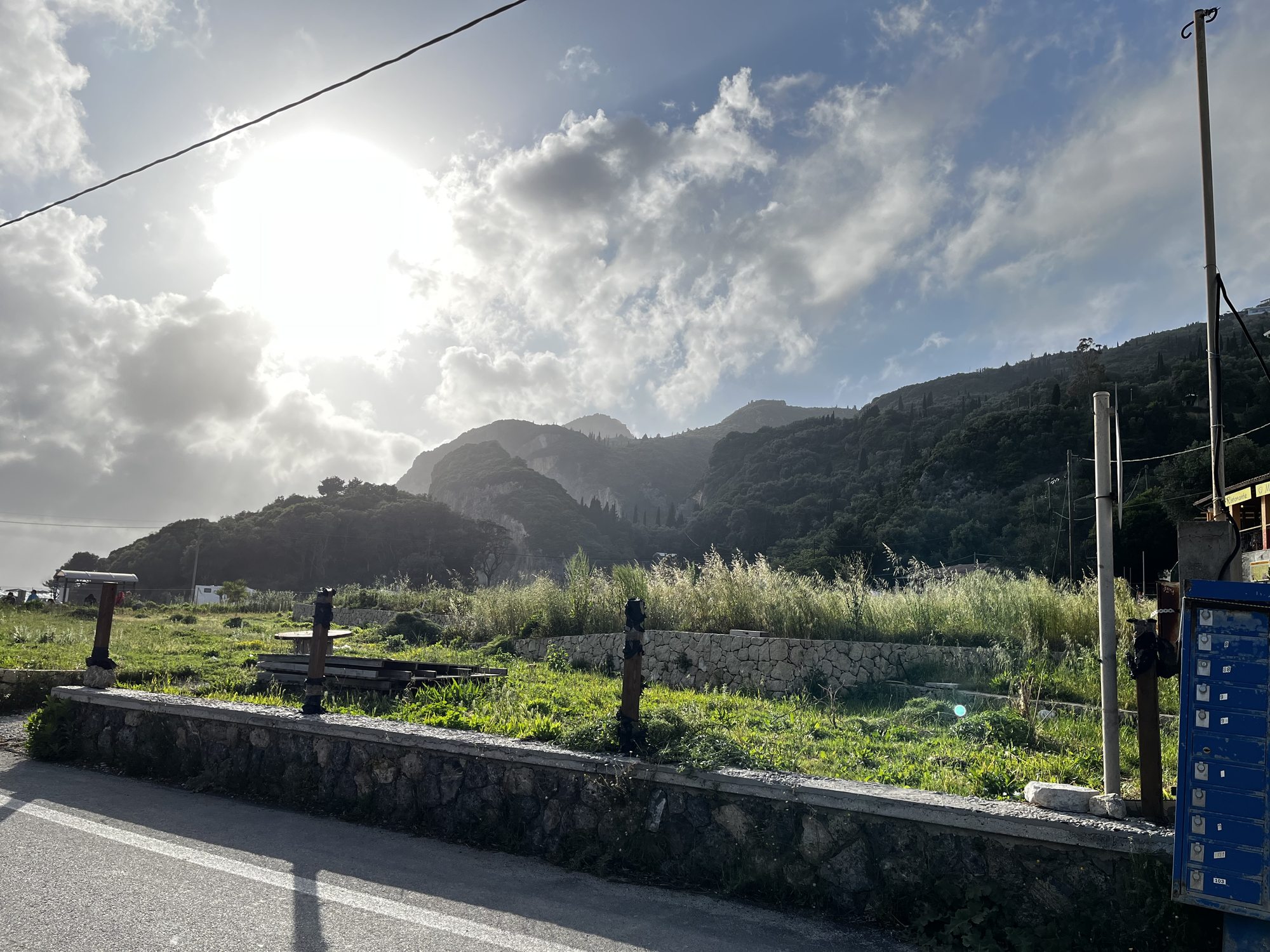
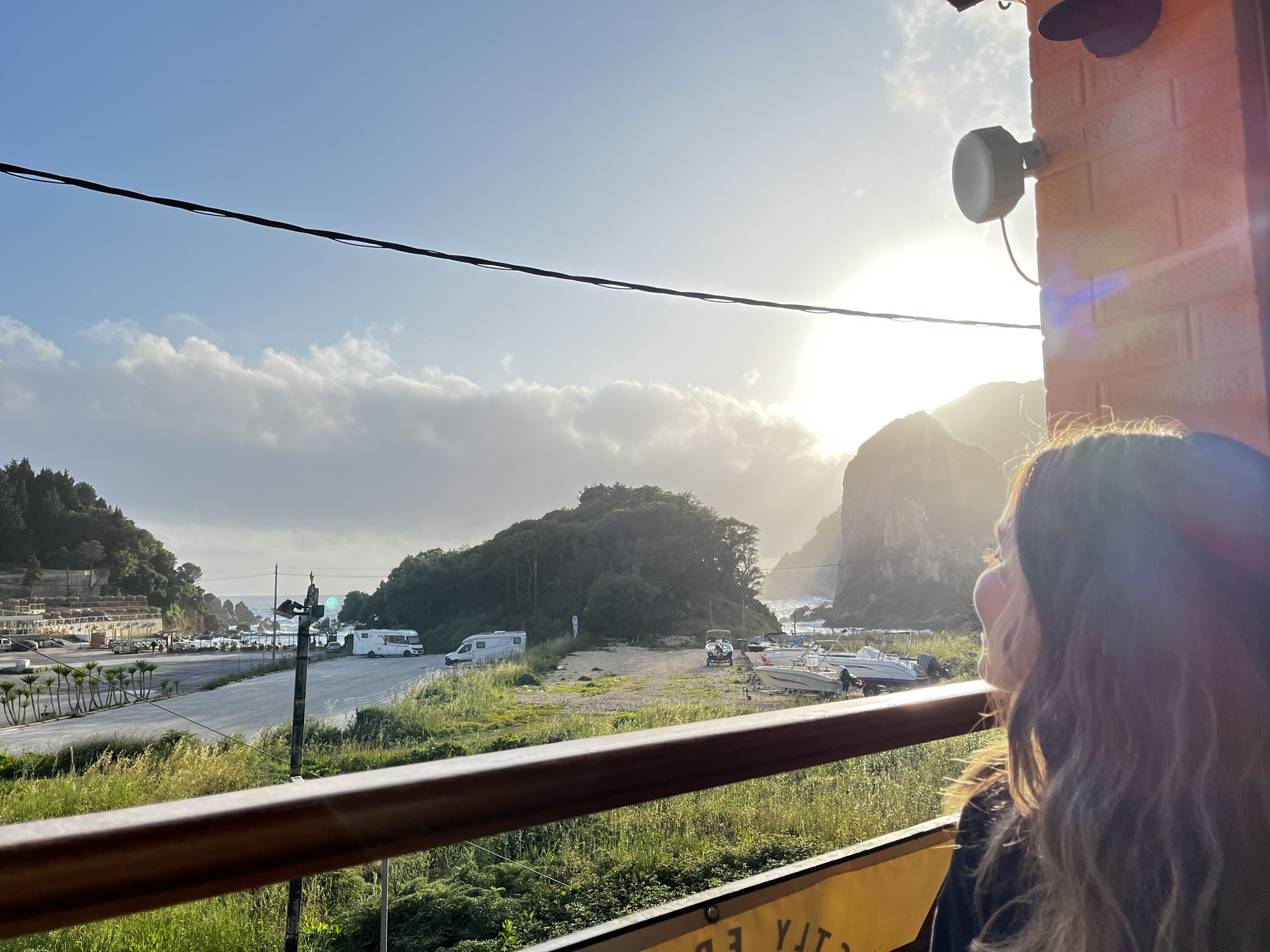
I have spent most of this piece on the cove and on the town. Let me give you the two evenings that were, between them, the second-half of the trip.
The Practical — the things you actually need to know
Corfu in July and August is a different island. The west coast roads bottleneck. The Old Town doubles in temperature. Paleokastritsa has standing room only on the beach. If you can avoid those two months, do — go in May, early June, or September. The sea is swimmable from mid-May through October. May and September give you the cove almost to yourself, the food at full strength, and twenty-five degrees in the shade.
Getting there: Direct flights from London, Athens, Rome, and most of central Europe in summer. Off-season, route through Athens. The flight from Athens is 55 minutes.
Where to stay: The west coast (Paleokastritsa, Liapades, Agios Gordios) for the beaches; the east coast (Corfu Town, Kanoni) for the history. If you only do one — do the west, and drive to the east for a day. The reverse trip is more crowded and less rewarding.
Driving: Mandatory. The bus system exists but does not connect the places you want to connect. Roads are narrow, paved, manageable. Do not rent a big car.
Language: English is widely spoken. Some older locals speak Italian as a second language before English — a leftover from the Venetian era, and from the time when half the island sent its sons to Italian merchant ships. A few words of Greek will be returned with warmth.
How long: Five days is the right length. Three is not enough for the west and the east. A full week is generous and you will not be bored.
What it costs (2026): Corfu is gentler on the wallet than the Cyclades. A small rental car runs roughly €30–50 a day in May or September (more in August), the Old Fortress is about €6, and a shared boat to the Paleokastritsa sea caves is €10–20 per person. The flight from Athens is typically €40–90 one-way. Rooms and tavernas cost noticeably less than Santorini for the same quality.
The Verdict — Go to Corfu before you go back to Santorini
I have written about Greece a few times on this site now. I have argued for Athens. I have given Santorini the credit it earns and the criticism it earns. I have made the case in Mykonos vs Santorini that the islands sell themselves in a narrow way, and I will end this piece by saying the same thing from the other direction: if you have already done the obvious Greek trip — even one of them — Corfu is the next island to book. Not for the postcard. For the opposite of the postcard.
Go for the green. Go for the cove that does not look like a Greek photograph. Go for the homemade plate on the blue-and-white plate. Go for the four hundred years of Venice and the twenty years of Napoleon and the fifty years of Britain that are still sitting under the Greek surface, waiting for someone slow enough to notice them. Go because the trip does not announce itself. It accumulates.
Go for the dog on the sand who picks you out of a beach full of people.
Base yourself on the west coast. Drive to the east coast for a day. Eat the pastitsio. Drink the kechribari. Climb to the monastery. Read the Schulenburg plaque. Sit at the Liston and pretend, for an afternoon, that you are in Paris. Get to know one beach, one taverna, one road, one dog. Go in May. Stay five days. Drive home with the windows down.
"Same country — different country."
If you want the other side of this Greek argument — the case for the city most people skip in favour of the islands — the Athens vs Santorini guide is the companion piece. It is the same instinct, pointed at the capital. The pattern repeats. The famous place is always the dessert. The interesting place is always the meal.
And for a piece that lives entirely outside this Greek conversation — the kind of trip nobody is selling and everyone should take — read I'm Armenian. I Just Visited Armenia for the First Time, written by my friend Nishan. It is the closest spiritual relative to this Corfu piece on the site, and the most honest "what nobody tells you" article we have published.
For the North American version of the "this place doesn't feel like its country" argument — the city most of my fellow Canadians have ignored for too long — read Quebec City — Europe without the flight. Same shape of surprise. Different continent.
Common questions — answered honestly
Is Corfu worth visiting?
Yes — and more emphatically than most travel guides will tell you. Corfu is the only Greek island that was never under Ottoman rule, the only one with four hundred years of Venetian architecture, and one of the few with beaches that look closer to Sardinia or the Caribbean than to the Cyclades. If you have already done Santorini or Mykonos and think you know Greece, Corfu is the island that will show you that you do not. Five days minimum. Go in May or September.
Should I go to Corfu, or to Santorini, Mykonos, or another Greek island?
It depends on the trip. For a first trip to Greece, choose Athens first — the case is in my Athens vs Santorini guide. For the iconic photo on a moderate budget, choose Santorini — the honest version is in is Santorini overrated. For beaches and nightlife, choose Mykonos. For the trip that breaks every Cycladic assumption — green hills, almost-tropical coves, layered Venetian-French-British history, slow homemade food on blue-and-white plates — choose Corfu. The article above is the full case.
Which Greek islands should you actually see?
For a first-time visitor with two weeks: Athens on the way in, Santorini for the photographic icon, and Corfu for the antidote to both. Skip Mykonos unless beach clubs are your thing — there is more island-Greece to discover and Mykonos's strengths can be found elsewhere for less. The wider Ionian — Kefalonia, Zakynthos — is the same green-and-Venetian world as Corfu and worth its own trip. Crete, Naxos, and Paros are the next tier.
How many days do you need in Corfu?
Five days is the right length. Three is not enough to cover both the west coast (Paleokastritsa, the beaches) and the east coast (Corfu Town, the Old Fortress, the history). A full week is generous and you will not be bored. The west coast for the beaches and slow time; the east for one full history-and-food day; the remaining days for the sea caves, a kumquat distillery inland, and an unplanned afternoon.
When is the best time to visit Corfu?
May, early June, or September. July and August are crowded and hot — the west coast roads bottleneck and Paleokastritsa beach loses its quiet. May and September give you swimmable sea, twenty-five degrees in the shade, the food at full strength, and the cove almost to yourself. We went in May. We would do May again.
Is Corfu expensive?
Less than the Cyclades, for the same or better. A small rental car is roughly €30–50 a day in shoulder season, the Old Fortress is about €6, and a shared boat to the Paleokastritsa sea caves runs €10–20 per person. The flight from Athens is usually €40–90 one-way, and rooms and tavernas cost noticeably less than Santorini for comparable quality. Corfu rewards the traveller who rents a car, cooks a few meals, and eats where the chalkboard is handwritten.
One practical note before you go. What you pay for a room on Corfu is shaped less by the hotel than by the two companies that own the booking sites you find it on. It is worth reading who actually owns online travel — and why it costs you.
Is Corfu overrated?
No — if anything, the opposite. Corfu takes real crowds in July and August, and the west-coast roads bottleneck, so in peak season it can feel busier than its quiet reputation suggests. But "overrated" means a place that cannot live up to its billing, and Corfu's problem is the reverse: most travellers skip it for the Cyclades entirely and never learn it is there. Green hills, Venetian streets, almost-tropical coves, and four hundred years of history that was never Ottoman make it the most under-sold island in Greece, not the most oversold. Go in May or September and the question answers itself.
Is Corfu a volcanic island?
No. Corfu is an Ionian island — limestone and green hills, not black volcanic rock. That is the whole point of it. Where Santorini is a caldera of ash and pumice with dark-sand beaches, Corfu is olive groves, cypress, and coves of pale pebble and clear water that look closer to the Adriatic or the Caribbean than to the Aegean. If you are picturing Santorini's cliffs, Corfu is the opposite kind of Greek island.
If you read this all the way down, there's a fair chance you've been somewhere too — and you have your own version of what just happened in this piece. I want to read it. I read every story that comes in, and I write back. The pieces that earn it go live here with your name on them, your photographs, your verdict.
This is what PONTUS
is built for.
Five days in Corfu. A small stone villa above the cove. A car for the week. Pastitsio and kechribari on a Tuesday night. This is the kind of trip that should be a long weekend, not a once-a-decade investment. PONTUS members access pricing on hotels, vacations and travel experiences that the public booking platforms cannot match — through a closed travel club that has been in place for over a decade.
See How It Works