Athens — for depth, food and value. Santorini for the view, the romance and two slow days.
The full verdictSame country — two completely different feelings. I don't blame anyone who's ever asked themselves: "Should I visit Santorini or Athens?"
Honest answer? Athens — and here's why.
The short version, from someone who has done both: Athens is the ancient, sprawling, budget-friendly city — world-class history (the Acropolis, the Agora, one of Europe's best museums), real food, and genuine urban energy. Santorini is the romantic, upscale island — the volcanic caldera, the cave hotels, the sunsets at Oia. Choose Athens for depth, food, and value; choose Santorini for the view, the romance, and a couple of slow days. If you can only pick one, Athens is irreplaceable: there is only one Athens, and Santorini is one of many beautiful Greek islands.
The ferry between them runs five to eight hours; the flight, about 45 minutes. Santorini is spectacularly beautiful and absolutely worth visiting. But Athens is irreplaceable. There is and will always only be one Athens — and Santorini is one of many beautiful Greek islands. The lines above tell you which one is for you. If you have a full week and want to do both right — plus Mykonos at the close — the 7-day Athens, Santorini and Mykonos itinerary is the operational version of this verdict.
| Athens | Santorini | |
|---|---|---|
| Best for | History, food, real city energy, depth | Views, romance, sunsets, a few slow days |
| Days you need | 5–7 — most people give it far too few | 2–3 — a day trip is mostly transit |
| Cost | Lower — a working city with real prices | Higher, especially caldera-view hotels |
| Peak-season feel | Big and walkable; absorbs the crowds | Beautiful but crowded; Oia at sunset is a crush |
| The one-line verdict | Irreplaceable — there is only one Athens | Spectacular, but one of many Greek islands |
Every piece here ends with an honest call on where to actually go. New verdicts land in your inbox first. One email. No noise.
Santorini — The Expensive Fairytale
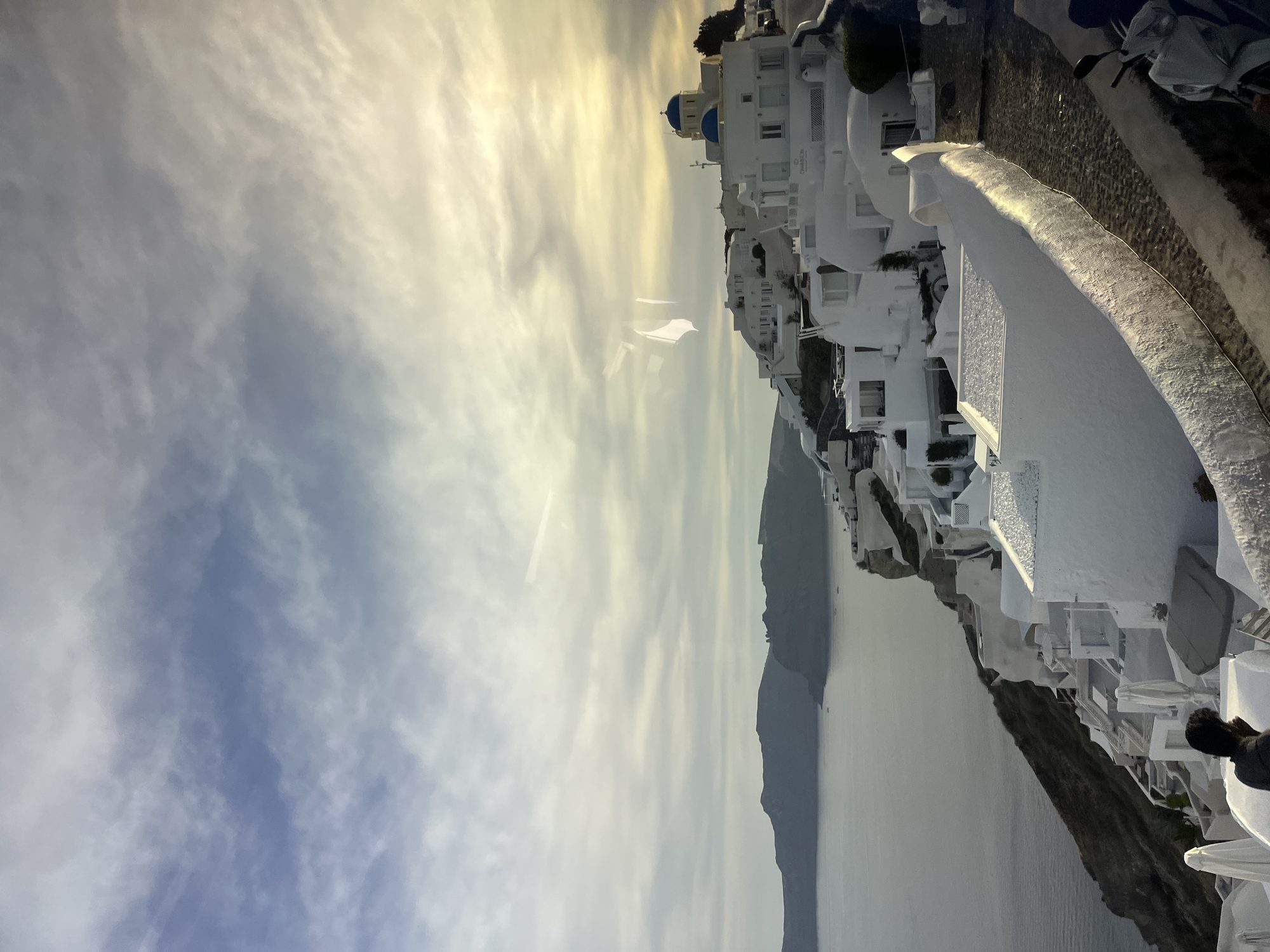
What Santorini is, is idyllic — spectacularly beautiful, straight out of a book or fairytale. There will be moments on the island where you look around and you genuinely get the urge to pinch yourself and check if all this is really happening, if you're standing where you're standing, if you're really seeing what you're seeing. Hundreds of photos of the classic white-and-blue island and now you're finally there, living the moment that millions long to live. Waking up to the smell of the caldera, the salt in the air, to the sound of the island and its inhabitants waking up for another beautiful day, watching the sun set over the Aegean — it truly is a privilege to experience it all.
But… there are caveats.
Before I get into what I consider to be the downsides, it's only fair if I first share with you what is great about Santorini. You are constantly surrounded by beauty. The food you eat is incredible.
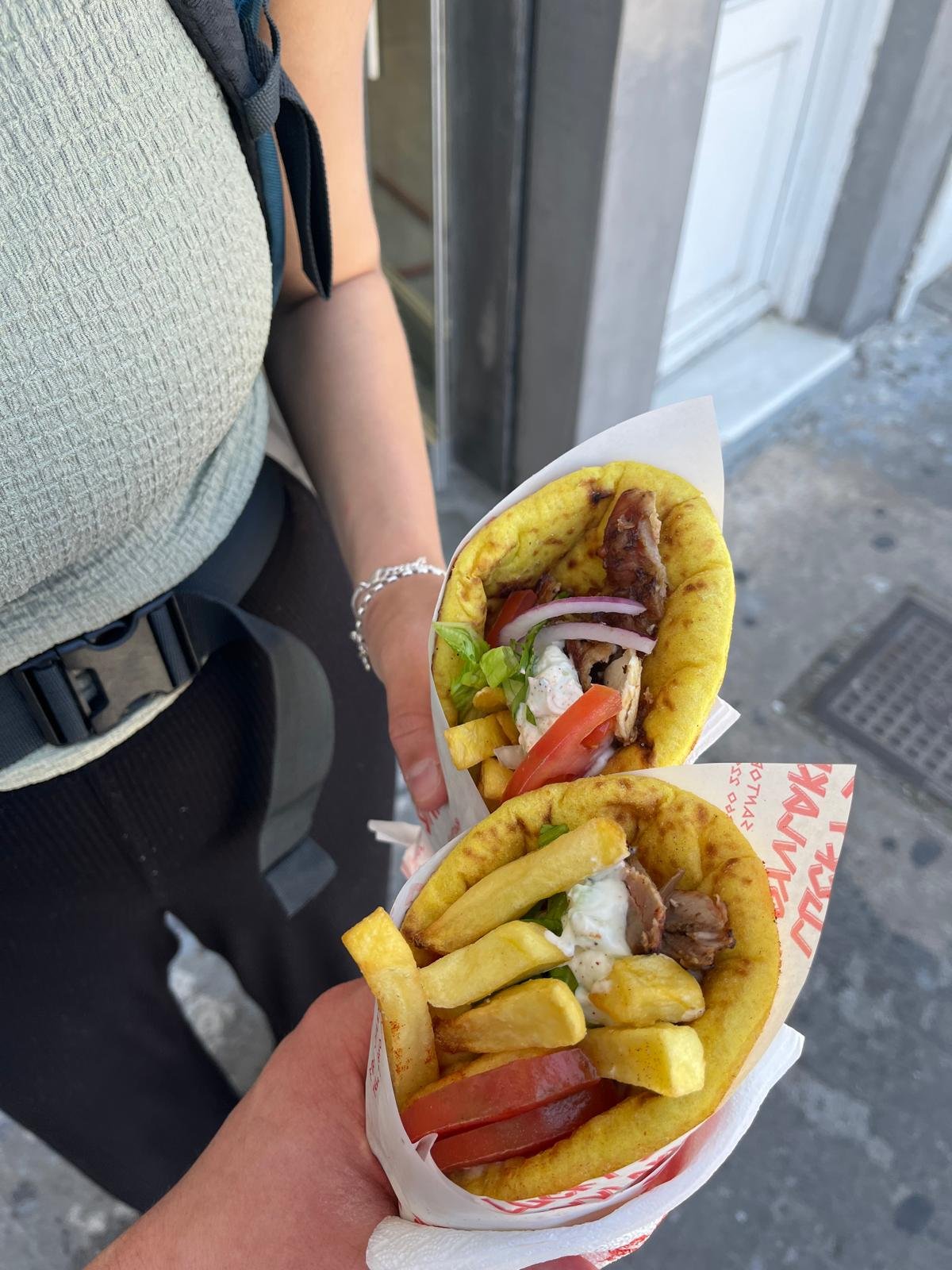
Short anecdote about one of the best culinary experiences I have ever had: I was in the town of Fira on the island of Santorini. There is this very popular small restaurant called Lucky's Souvlakis. You order either your chicken, pork or lamb gyro and you watch them prepare your meal right in front of your eyes. As you're standing there waiting, you are surrounded by the smell of deliciousness and the salty caldera air all around you. I ordered a pork gyro, as was recommended to me by the cook. My girlfriend and I took our gyros, walked a few steps to the right, took a few steps up to our left — and there you are, looking at one of the most magnificent views of the Santorini caldera you will ever see. You bite into your gyro — and you simultaneously see and taste Greece all at the same time. It will forever be an unforgettable experience — and one that I cannot wait for you, dear reader, to experience as well.
The honest downsides
Now, for what I consider to be some unfortunate downsides — with full transparency. It is not very budget friendly. Those idyllic pictures you see of couples in their private hot tub or pool in their beautiful private room overlooking the caldera? Yeah… those are very few and very expensive. My girlfriend and I had to find an Airbnb about a 10–15 minute walk from the nearest town — which was Oia in northern Santorini. The room was fine, by all means. However, when people think of staying on the island, social media makes it seem like you are totally going to stay in these scenic rooms overlooking the best view ever. That's just not the case for the vast majority of travellers.
The food — although fantastic — is also expensive. The nicest restaurants are often fully booked, and reservations are mandatory for some of them — not always by policy, but if you want to have a chance of getting a spot there. My girlfriend and I often found ourselves going to a little grocery store and making some simple food at our place rather than going out to eat.
Third, Greeks are known for their chilled-out demeanour when it comes to timing and being on time. If a bus, online, states that it arrives at 4pm — you can almost always bet that it will come later. It will arrive, for sure — but later. It's not exactly ideal to entirely bet your itinerary on the buses arriving at their planned time. Most of the time, that wouldn't matter too much. However, as I've stated — Santorini is expensive and more often than not, you are not spending weeks there, but a few days. Losing valuable time, often hours of your Santorini stay waiting on buses and public transport does take away from the experience.
"You will feel like you're in a fairytale — although… a quite expensive fairytale."
To recap: Santorini is gorgeous and most definitely worth visiting. The experiences — visual and culinary — that the island offers are undeniable. You will feel like you're in a fairytale — although a quite expensive one. After spending a few days to a week there, you do kind of feel like you've seen all there is to see and are ready to move on.
Is Santorini worth visiting on a budget?
Yes — but only if you adjust the expectations rather than the destination. My girlfriend and I did Santorini on a budget. We stayed in an Airbnb a 10–15 minute walk from Oia. We cooked some of our meals in the kitchen rather than eating at every caldera-side restaurant. We did the Fira-to-Oia hike, which is free and the best thing on the island. We took the bus rather than the rental car. We did one wine tasting instead of three. The trip was still spectacular. The Instagram version — the cave suite with a private hot tub overlooking the caldera at €800 a night — is not what most people are actually buying. Most people are walking the same streets, eating at the same affordable tavernas, and watching the same sunset from the same public viewpoints. The view is free. The hike is free. The caldera is free. That is most of why you came.
Athens — The Ancient City That Gets Under Your Skin
I'll be honest with you: I've been sitting here thinking of how to start this section for about two hours. It's just quite hard to put into words what Athens is, what Athens feels like, and why — for some reason — I feel so damn nostalgic and long to return to it. So I suppose the best place to begin is at the beginning.
My girlfriend and I arrived at Athens International Airport around noon. Throughout the hustle and bustle of the airport, the slight confusion of finding the right bus and metro to take — for a moment I forgot where I was, I forgot that I was finally in Athens. We were just trying to get to where we needed to go. We arrived at the underground Monastiraki station and headed up out of the underground into the neighbourhood called Psiri. We were finally in Athens, shops around us, cars passing by, the smell and feel of the ancient city. Already, then and there, I thought it was so cool that we had arrived — but then my girlfriend said "baby, look up!" — and there it was: the Acropolis. Towering over the ancient city, changed but unmoved, broken but still standing, ruined but glorious. Admittedly, as a fan of ancient Greek history, I was awe-struck. All the sweat and tiredness of the commute and travel leaves your body and the feeling is replaced by a hunger to see more.
The city is a marvel to fans of history, and for the non-fans it remains a living, breathing museum that interests anyone. As you walk to your hotel or Airbnb, you are bound to pass by these fenced-off sections in the city. What these sections fence off are ancient Athenian ruins that the city decided to leave right there, right where they have been laying for thousands of years. You realise something quite early on while walking through the city: you are not just an observer — you are a participant. You are participating in the ongoing history of this ancient city. You are walking the paths that the ancient Greeks walked thousands of years ago. And nowhere, in my opinion, is that truer than the ancient Athenian Agora.
The Agora — the heart of the ancient city
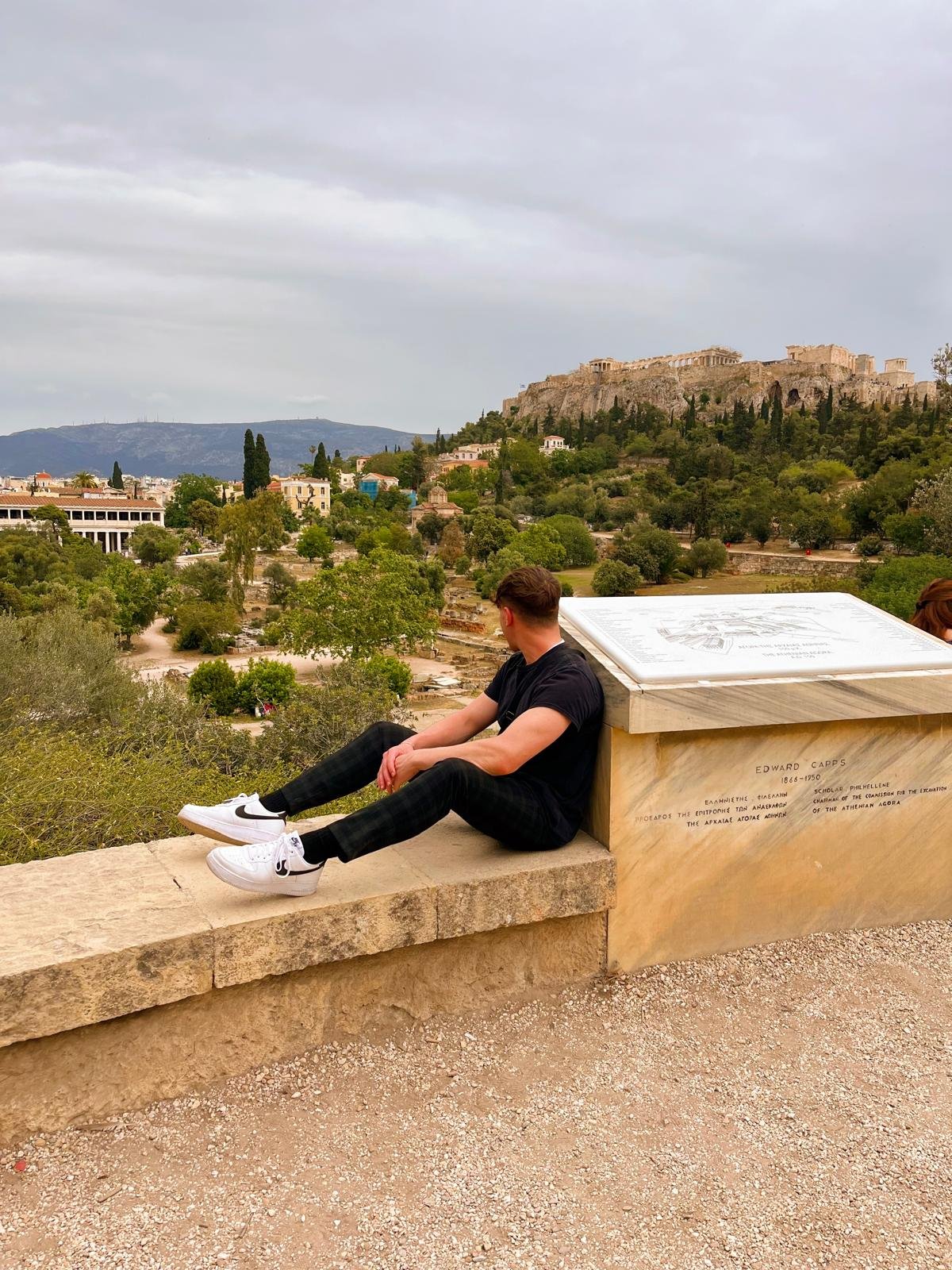
The Athenian Agora may be a classic Athens tourist destination now, but at the height of Ancient Athens it was the social and economic centre of the city. It is where people set up their markets. It is where philosophers — including the famous Socrates — walked and sat and gave speeches. It is where news would be shared, where classes were given — it was the heart of the city. Just nearby is the Temple of Hephaestus. Not only is it one of the most beautiful, glorious, best-preserved ancient Athenian temples ever built — it also overlooks the Agora. So there you are: one of the most spectacular ancient temples that exists in this day and age behind you, and in front of you you're overlooking the ancient heart of this ancient city. Athens, with these kinds of moments, forces you to slow down, sit down, and take it all in.
The Acropolis — and why the hill matters more than the Parthenon
The Acropolis may just be the pinnacle of that feeling. The Acropolis is this ancient hill which housed various important and religious structures — the most popular and biggest being the famous Parthenon. Throughout various wars and conquests, those structures have been defiled, destroyed and ruined — but their remains stand tall on the hill, nevertheless. Some people complain about the almost constant ongoing construction, but I personally did not mind it at all. The majesty of the Acropolis, for me anyway, wasn't the Parthenon or any specific ruin on the hill — but the hill itself. It is at the heart of the city and it is not walled off on any side. Meaning, you are surrounded, in plain view, by Athens all around you. You see and hear and feel and smell the ancient city everywhere you look. You are overlooking the same Agora, the same streets and the same distant mountains and hills that the ancient Athenians overlooked from that same hill and that same height. It truly is an absolutely breathtaking experience.
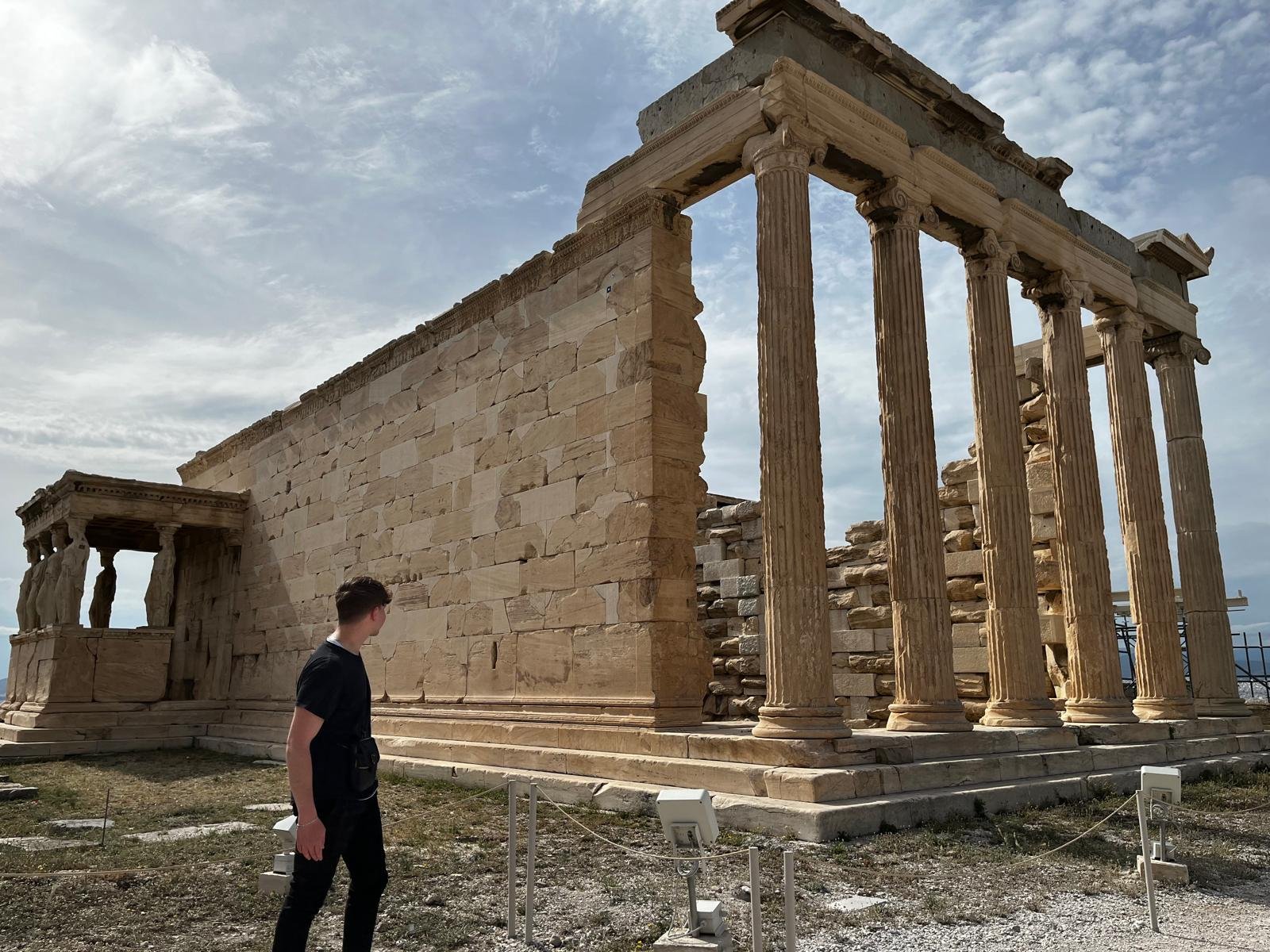
A word on the museums too. Yes, the city itself is a museum — but as I mentioned, Athens has been through the wringer in the past. It has been conquered and partially destroyed more than once. So in order to preserve its remaining history and artefacts, the city has placed various ancient objects that would normally be on the Acropolis into museums for safekeeping. My recommendation: visit the Acropolis first, then visit the museum to see all the other various things that were found and used to be on that hill, on the Agora and in various other ruins. The sequence matters — you need the experience of standing in those places before the objects behind glass mean anything.
The food — follow the locals, always
Spectacular, but you have to know where to go. In the case of Athens, just like in the case of Rome, Madrid, Lisbon, or any of these highly touristy cities, the golden rule is: follow the locals. If you think the way to go is to find one of those restaurants with English signs, English menus and a line of tourists sitting outside — you will be disappointed. The trick is to go slightly further into the city — and when you stop hearing English around you, you'll know you're on the right track. Eating at the spots where the locals eat gives you two things: much better prices, and much better food. It's also quieter, more intimate and a truer window into what Athenian daily life actually looks like. The food doesn't have a visual wow factor, but it tastes so authentic, so unique — like you are tasting local recipes that have been kept and passed down for generation upon generation. If you're weighing Greek food against Italian on one Mediterranean trip, a contributor settles that exact question in Italy vs Greece.

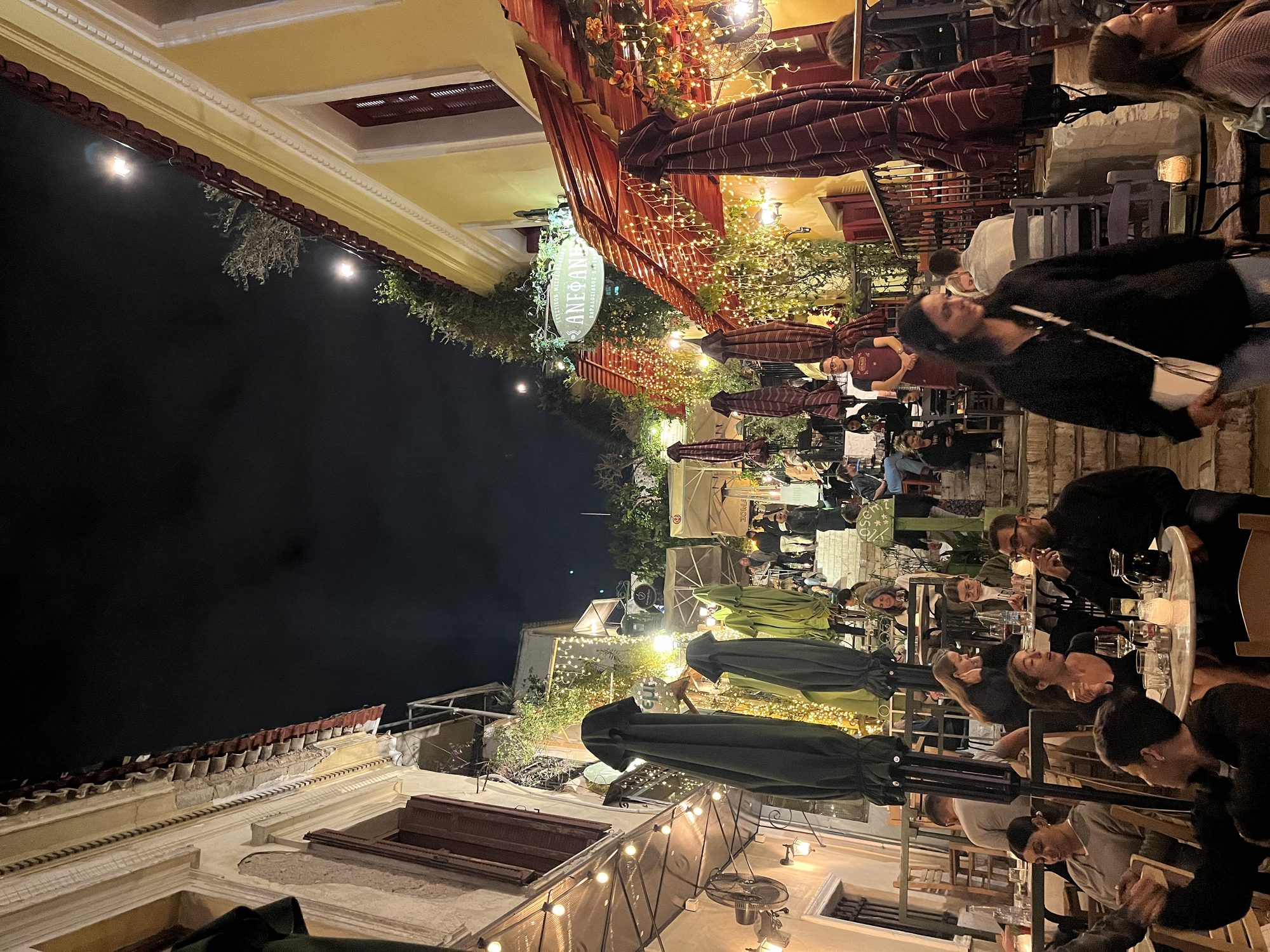
Athens — the things worth knowing before you go
Getting around: The metro from the airport to Monastiraki is inexpensive, fast, and takes you directly into the heart of the old city. Skip the taxis on arrival.
The Acropolis: Go early — before 9am if you can. The light is better, the crowds are smaller, and you'll have moments of near-silence up there that disappear completely by midday. The single-site ticket is €30 (2026); note the old multi-site combo ticket was discontinued in 2025, so the Ancient Agora and the other ruins are now separate tickets. Buy online in advance and skip the queue.
Neighbourhood to base yourself: Psiri or Monastiraki puts you within walking distance of everything that matters. Avoid the tourist-heavy hotel strips near Syntagma if authenticity matters to you.
How long: A minimum of five days. A week is better. Athens rewards the visitor who slows down — rushing it is the one thing you can genuinely do wrong here.
For travellers who’d like to extend their relationship with the place — and with the people who write about it — the PONTUS community runs a private travel membership. Read about the community side →
Before you book either city: the price you see is rarely the price that has to exist. We trace who actually owns online travel — and why it costs you.
We spent a week in Athens — and I felt like I barely scratched the surface. Not all of Athens is as visually stunning as Santorini, but my goodness does it have depth. The locals feel real and authentic, the local food is absolutely delicious, you are continuously walking through a living museum — and most importantly, you long to go back to it. You long to visit it again.

How many days do you actually need in Athens?
Most people give Athens two nights. Most people are wrong. Five nights is the minimum. Seven is better. Day one is your arrival and the long evening walk through Psiri and Monastiraki. Day two is the Acropolis at dawn and the Acropolis Museum in the afternoon. Day three is the Agora and the Temple of Hephaestus — and you sit for an hour on the stones and the city stops being a checklist. Day four is Filopappou Hill, the National Archaeological Museum, and dinner where the locals eat. Day five is the day Athens stops feeling like a destination and starts feeling like a city you've lived in for a week. That is the day you needed. Cut the trip short and you will not get it.
How to combine Athens and Santorini in one trip
If you have a week or more and you want to do both — which is the right call if the budget allows — start in Athens and finish in Santorini. The order matters: Athens is the city that earns its weight in time spent, and you will not enjoy walking it after the slow rhythm of an island. Spend at least four to five nights in Athens, then take the ferry or the short flight to Santorini for two to three. Aegean and Sky Express run the 40-minute flight — daily year-round, with far more options May through October — and one-way fares typically run €40 to €120 depending on season and how early you book. The ferry leaves from Piraeus, Athens's port, and takes 5 to 8 hours depending on operator and weather: Blue Star's conventional boat is the cheaper, more honest entry into the islands at roughly €48 to €65 a seat, while the SeaJets high-speed is faster but often €90 or more. Book either well ahead in peak.
Timing: aim for May or early October on both. The light is at its best, the crowds thin out, and prices drop 20 to 30 percent compared to August. In Athens, stay in Psiri, Monastiraki, or the lower edge of Plaka — walkable to everything, real-neighbourhood, not the tourist hotel strip near Syntagma. In Santorini, stay in Oia for the view, Fira for convenience, Imerovigli if you want the caldera at lower decibels. Book three to six months ahead in peak. The best places fill first and the rest double their prices to fill the gaps.
The Verdict — And Why It Matters
Ideally, of course, the answer to Athens vs Santorini is: both. However, not all of us can afford to visit two locations and more often than not, we have to pick one to respect our budgets. In that case, if you are to only visit one of these locations — my honest opinion is that without a doubt the way to go is Athens.
Santorini is one of many beautifully stunning Greek islands — among others such as Mykonos, Naxos and the famous Crete. In many ways, they share the same language of beauty: spectacular views of the sea, white-washed villages, beaches that make you question every beach you've ever been to before. But there is and will always only be one Athens.
If you have already done both Athens and Santorini — or you are planning your second Greek trip and want a third option that breaks the Cycladic pattern entirely — read Corfu — the Greek island that doesn't feel Greek. Four hundred years of Venetian rule, a French colonnade in the centre of town, British cricket on the Spianada, beaches the colour of the Caribbean. Same country — different country.
And if Athens earned its place by being the European-ness that the islands cannot give you, the closest North-American equivalent is two hours from Montreal: Quebec City — Europe without the flight. Stone walls. French language. Four hundred years of continuous old town. The closest your continent will give you.
There is, for similar reasons, only one homeland — and for those of us with one, the trip back is a different kind of irreplaceable. Nishan, a contributor to PONTUS, writes about that exact feeling in I'm Armenian. I Just Visited Armenia for the First Time — and it is the closest thing to Athens, in spirit, that I have read in a long time.
"Changed but unmoved, broken but still standing, ruined but glorious. There is and will always only be one Athens."
Common questions — answered honestly
Which is better, Athens or Santorini?
Athens — if you can only choose one. Santorini is spectacularly beautiful and absolutely worth visiting, but Athens is irreplaceable. There is and will always only be one Athens; Santorini is one of many beautiful Greek islands.
Should I visit Athens or Santorini first?
Athens, and give it most of your time. Start in the city, then add Santorini as a shorter island leg at the end — you won't enjoy walking Athens after the slow rhythm of an island.
Is Athens worth visiting?
Yes — emphatically. Athens is a living ancient city: you walk the same streets and sit above the same Agora the ancient Greeks did, you eat where the locals eat, and you feel a depth Santorini's beauty simply cannot give you. Plan at least five to seven days.
Is Santorini overrated?
No — it's spectacularly beautiful and worth visiting. It just isn't the only option, and it isn't irreplaceable the way Athens is. Calling it overrated is unfair; calling it a must-see is overstated. I make the full case in Is Santorini overrated?
How long should I spend in Athens vs Santorini?
More time in Athens than people usually suggest — five to seven days. Santorini works well as a two-to-three-night addition. Most travellers do the opposite, and most travellers regret it.
Can you visit Santorini as a day trip from Athens?
Not realistically. It's a 40-minute flight or a 5-to-8-hour ferry each way, so a day trip is mostly transit. Give Santorini at least two nights and treat it as its own leg of the trip.
How much does a trip to Athens and Santorini cost?
It varies, but a few 2026 anchors: the Acropolis is €30, the Athens-to-Santorini flight runs roughly €40 to €120 one-way, and the ferry from Piraeus starts around €48. Travel in May or early October and prices across both drop 20 to 30 percent versus August.
If you read this all the way down, there's a fair chance you've been somewhere too — and you have your own version of what just happened in this piece. I want to read it. I read every story that comes in, and I write back. The pieces that earn it go live here with your name on them, your photographs, your verdict.
Everyone should get to
experience this.
This is why I started PONTUS. We all live one life — and everyone should have the chance to experience these things. We're a community of people who believe travel should be a way of life, not a luxury reserved for the few.
- For those who want to be part of a community of like-minded people
- For those who don't want to break the bank just because they want to see the world
- For those who are ready to put the effort in and build their own income from the travel industry
Whatever you want, whatever you choose — PONTUS is here.
Join the Community